

Why Your Shop Can’t Afford to Skip Formal Press Brake Training
The metal fabrication industry faces a widening skills gap as experienced press brake operators retire.
This makes structured training programs essential for maintaining production quality and throughput. Untrained operators increase scrap rates, extend setup times, and introduce safety risks.
That is why Capital Machine delivers comprehensive press brake training through our 43 factory-trained field service engineers positioned across our 22-state territory. We combine OEM-level technical knowledge with hands-on shop floor experience in our training courses.
What You Learn in Capital Machine’s Press Brake Training Program
Capital Machine’s press brake training program covers press brake fundamentals including machine components (such as rams, dies, back gauges, and control systems); bending theory; material science; and
K-Factor calculations for springback compensation. We provide a complete technical foundation that covers everything you need to know from the Fabricators and Manufactures Association (FMA) Precision Press Brake Certification Program.
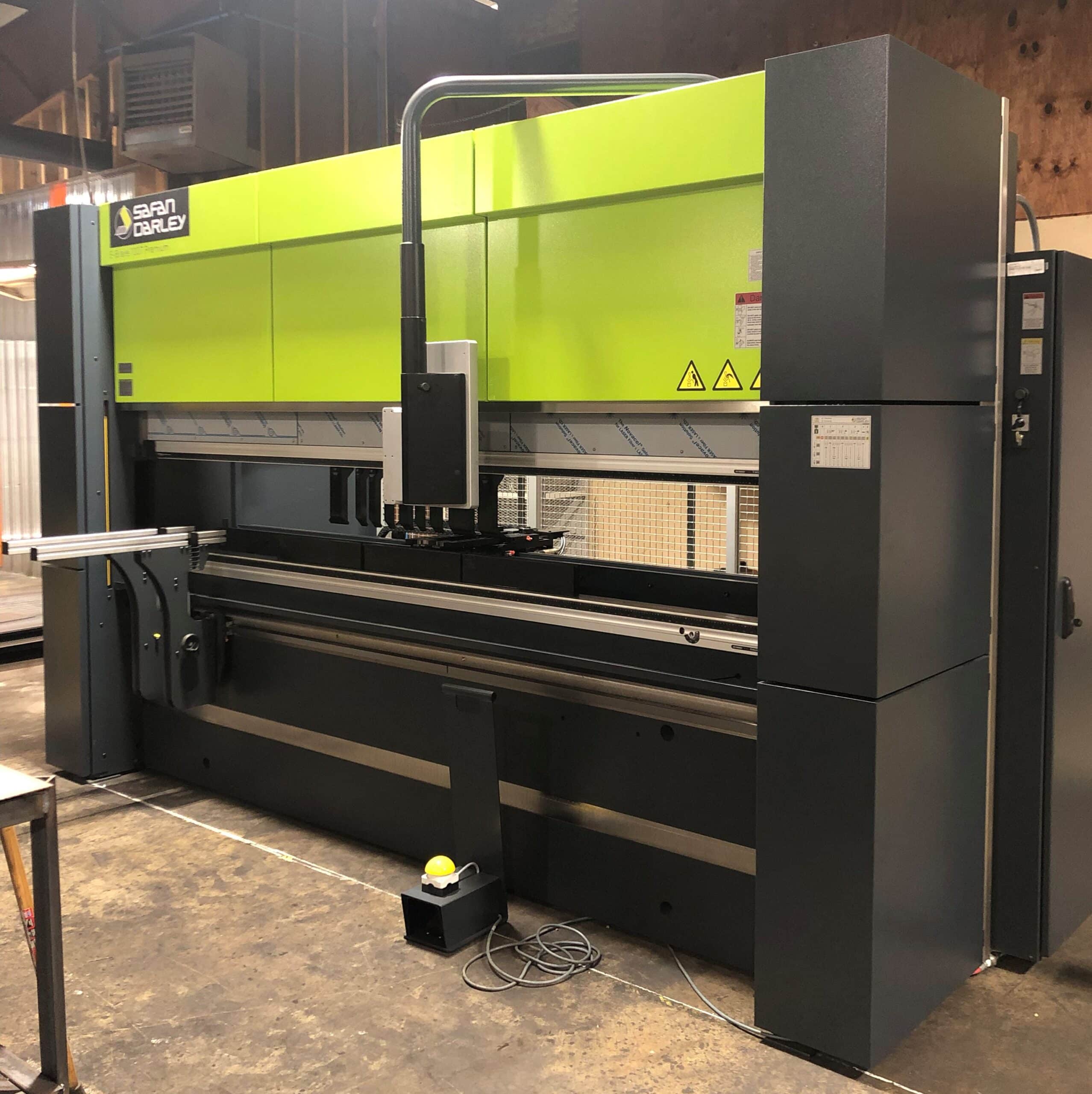
Our training is built around the Accurpress press brake lines and SafanDarley servo-hydraulic and electric press brakes, so operators learn on the exact equipment they will use in production. Our curriculum progresses from reading blueprints and bend deduction calculations through tooling selection, setup procedures, and quality verification. This mirrors the operator progression stages from beginner to confident production-level performance.
How Press Brake Safety Training Keeps Your Team OSHA-Compliant
Capital Machine’s press brake safety training covers pinch point hazard awareness, proper hand placement and body positioning, personal protective equipment (PPE) requirements, and emergency stop procedures. These are all areas governed by OSHA 29 CFR 1910.212 and the OSHA Directive STD-01-12-012 and specific to power press brake guarding, which references ANSI B11.3 compliance standards. Operators learn to work with light curtains, laser safety systems, and other active opto-electronic protective devices (AOPDs), plus Lockout/Tagout (LOTO) procedures for maintenance situations.
Capital’s 43-factory-trained field service engineers, all full-time employees and not subcontractors, teach safety as an integrated part of every training session rather than as a standalone module, reinforcing safe habits from the first hands-on interaction with the machine.
Hands-On Press Brake Training at Six Technology Centers
Capital Machine conducts training at its five technology centers. Our facilities in Atlanta, GA; Dallas, TX; Indianapolis, IN; Harrisburg, PA; and Tampa, FL are all equipped with press brakes under power, so operators train on real production equipment, not simulators.
On-site training is available across our 22-state service territory, where our 43-factory-trained field service engineers bring curriculum directly to the shop floor and tailor instruction to the specific machines, tooling, and part geometries each facility runs.
How Tooling Knowledge Cuts Your Changeover Time and Scrap Rate
Tooling selection directly affects bend quality, part accuracy, and cycle time. Operators trained on correct punch and die matching for material type and thickness eliminate common sources of scrap and rework. Our training covers tooling from conventional planer ground tooling as well as precision quick change tooling Wilson Tool and WILA. We teach operators setup optimization, proper storage protocols, and wear inspection routines that extend tool life and maintain tolerance operation consistency.
Shops running high-mix, low-volume production will benefit most from tooling training as operators may handle multiple setups per day. This training will reduce changeover time with proper technique and organization.
Your Operator’s Path from Beginner to Production-Ready in Months
Operator skill progression typically moves through defined stages. Foundational safety and machine bending basics are the first month of training, supervised production work and bend calculations takes two to three months, and independent operation with complex part geometries takes six months to a year. Entry-level operators can become job-ready in three to six months through structured on-the-job training.
Capital’s training approach includes not just initial instruction but retraining and application support after operators are running production. This helps address the reality that skills degrade without reinforcement, especially when new materials or part designs enter the mix. Post-training application support is provided by our 43-factory-trained field service engineers in conjunction with our Applications department. This means operators and shop managers have a direct line to technical experts when they encounter unfamiliar bending challenges —a resource most OEM-only training programs do not provide.
How Maintenance Training Protects Your Press Brake Uptime
Operators trained in daily and weekly maintenance checks of hydraulic fluid levels, ram alignment, back gauge calibration, and tooling wear inspection will catch issues early and prevent the kind of unplanned downtime that halts production. We also offer condition-based maintenance programs that complement operator training by providing systematic equipment health monitoring beyond what operators perform day-to-day.
Our service vans are stocked with critical parts and staffed by our 43-factory-trained field service engineers that provide rapid break-fix response when issues exceed operator-level maintenance. This keeps the total support system connected from daily checks through major repairs.
Schedule Your Press Brake Training With Capital Machine
Shops can schedule press brake operation training at any of our six technology centers or request on-site training at their facility anywhere within our 22-state service territory, with flexible scheduling built around production demands.
Beyond initial training, we provide ongoing retraining, application support, and access to our 43-factory-trained field service engineers. This creates a continuous learning relationship rather than a one-time class, which is a core differentiator from OEM-only training and third-party certificate programs. Contact us today.