
Why the Right Press Brake Makes or Breaks Your Shop’s Profitability

Press brakes represent a significant capital investment for any organization. Costs typically range from $150,000 for mid-range hydraulic models to $500,000+ for high-end computer numerical control (CNC) and electric configurations depending on the length and tonnage. This makes the selection decision one of the highest-impact equipment choices a fabrication shop will face. How to choose a press brake, and the right one for your shop’s needs, can seem quite difficult.

Press brake selection directly affects your shop’s production efficiency and profitability by determining bending speed, setup times, and accuracy. This directly influences labor costs, material waste, and throughput. Below are some common buying mistakes to avoid.

Common Buying Mistakes to Avoid

  • Over-specifying tonnage: You end up paying for capacity you don’t need or use.
  • Under-specifying bend length: This can limit future job flexibility.
  • Ignoring the total cost of ownership: Maintenance, operator training, tooling, and press brake dies.

Capital Machine Technologies can make choosing the right press brake much easier. We can help by taking an advisory approach to press brake selection, evaluating each shop’s actual production mix, material types, and growth plans before recommending equipment. Our consultative process is built on 40+ years of working with job shops and mid-market manufacturers across 22 states.

This is why we have six technology centers under power for you to test out real-world applications. This allows you to make a much more informed decision. At each technology center we have our full lineup of press brake machines under power. Our technology centers are located in Tampa, Florida; Atlanta, Georgia; Norcross, Georgia; Dallas, Texas; Indianapolis, Indiana; and Harrisburg, Pennsylvania.

Hydraulic, Electric, or Hybrid: Which Press Brake Technology Fits Your Production

Finding the right press brake for your shop is critical. This is why Capital Machine offers hydraulic, electric, and hybrid press brakes for you to select from. Hydraulic press brakes, such as the Accurpress Advantage, Accell-E, Accell-U and Accell-HT, remain the workhorse of the industry. These models offer a high-quality build, an impressive number of features and options, and advanced controls.

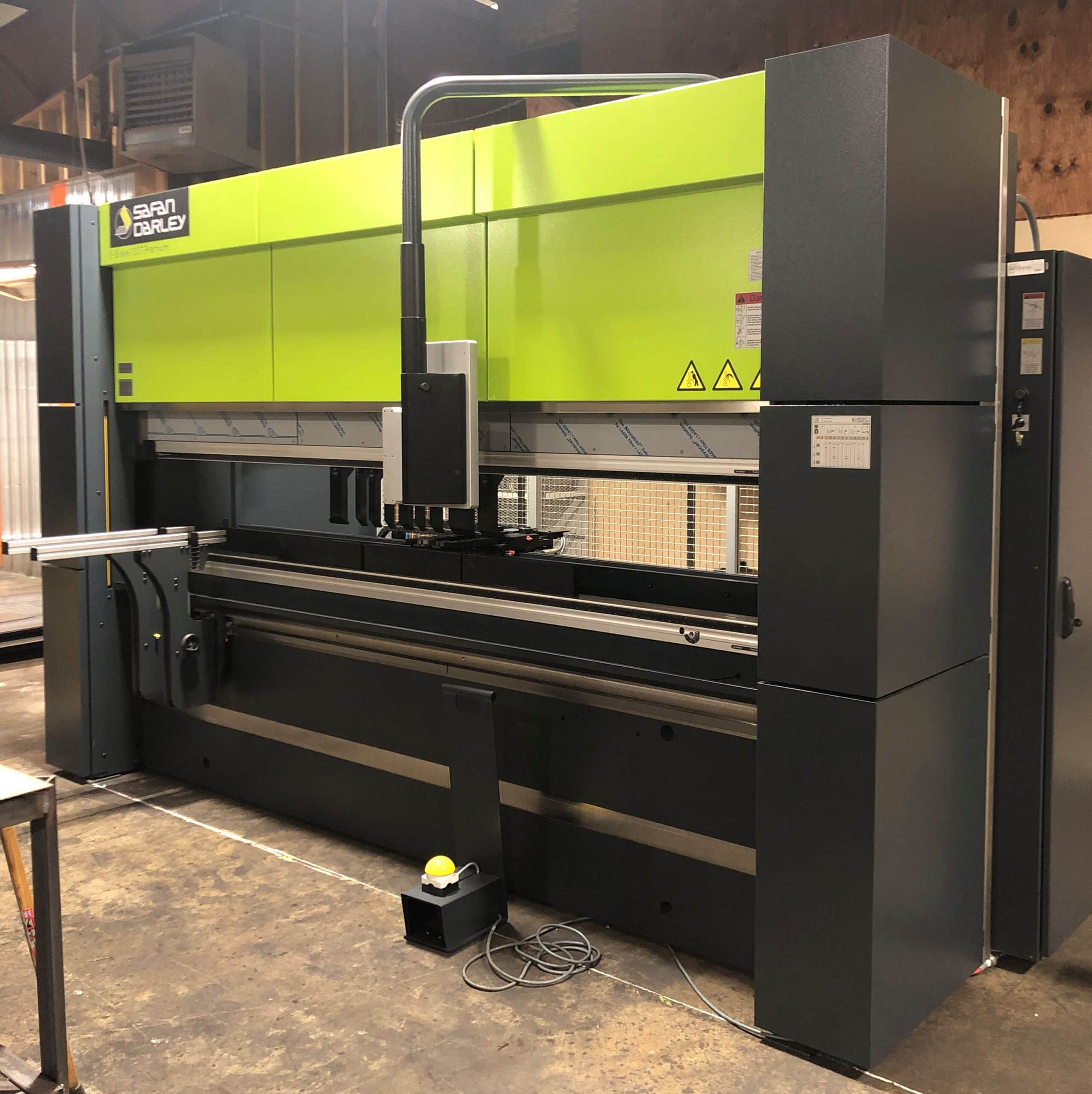
Electric press brakes, like the SafanDarley E-Brake Series, deliver faster cycle times than conventional hydraulic machines, with lower energy consumption and reduced maintenance. SafanDarley is the innovator and patent holder for the first all-electric e-brake, first introduced in the mid-90s. The SafanDarley E-Brake ranges from 39 to 330 tons and has a complete range of options for specific applications. This makes electric press brakes ideal for shops running repetitive, precision-critical production.

Hybrid press brakes, such as the Accurpress Accell H, combine electric pump technology with hydraulic force delivery, offering energy efficiency, while maintaining the tonnage flexibility of hydraulic bending machines. This is a growing choice for shops balancing sustainability goals with heavy-duty bending machine requirements.

How to Calculate the Exact Tonnage Your Press Brake Needs

Tonnage requirements for your shop’s particular needs will depend on the material type, thickness, bend length, and die opening. The Rule of 8 is a good guide and the industry-standard starting point for calculating required force and selecting appropriate tooling for a press brake.

Different materials will require dramatically different tonnage for the same sheet metal thickness. Mild steel requires 60,000 PSI tensile strength and is the baseline at 1.0x. Stainless steel requires 90,000 PSI and roughly 1.5x the force. Aluminum requires roughly 0.5x the force. This makes material mix a critical input to the tonnage calculation and the bending force required.

Our advisory team can help shops avoid both over-specifying, or wasting capital on unused capacity, and under-specifying, or limiting future job capability, by analyzing actual production data and anticipated growth.

How Bend Length, Precision, and Tooling Shape Your Press Brake Decision

Bending length should be selected based on the longest part you regularly produce plus a margin for future work. Going too short locks you out of larger jobs, while excessive length adds cost without proportional benefit.

Precision requirements will vary by application. HVAC and general fabrication may tolerate +/- 1 to 2 degrees, while electrical enclosure work often demands +/- 0.5 degrees to maintain uniform door seams and gasket compression. The choice between air bending, bottom bending, and coining directly affects achievable bending accuracy.

Press brake tooling systems, such as American standard vs. European style, and manual vs. hydraulic clamping, affect both changeover speed and precision. Shops running high-mix production with multiple setups per day will see significant productivity gains from quick-change tooling systems.

Capital Machine can assist shops in finding the right press brake tooling to make your work easier. This will allow your shop to bend metal quicker and safer. Our six technology centers are a great place to test out your shop’s applications. Out centers are under power so you can test out our quick-change tooling systems and make test bends under real world conditions. Our technology centers are located in Tampa, Florida; Atlanta, Georgia; Norcross, Georgia; Dallas, Texas; Indianapolis, Indiana; and Harrisburg, Pennsylvania.

How CNC Controls, Back Gauges, and Automation Cut Your Setup Time

CNC press brakes with programmable back gauges and angle correction dramatically reduce setup time and operator dependency. This is critical for shops handling dozens of different parts per shift where manual adjustments on every bend would consume hours of productive capacity.

Advanced back gauge systems with multi-axis and programmable finger positioning, enable complex part geometries without manual repositioning. This is a feature that pays for itself quickly in shops producing parts with multiple bends at different depths and angles.

Robotic bending cells, such as the SafanDarley R-Brake, integrate the press brake with automated part handling, enabling lights-out or reduced-labor production. This is an increasingly viable option for mid-market manufacturers running higher-volume, repeatable parts.

Safety Features You Should Require Before Buying Any Press Brake

Modern press brakes should incorporate appropriate safeguarding, which may include light curtains, laser safety devices, two-hand controls, and emergency stop controls where applicable. OSHA’s general machine guarding requirements are established under OSHA 29 CFR 1910.212, with additional guidance for power press brakes provided in OSHA Directive STD-01-12-012.

Advanced safety systems, such as active knock-out avoidance systems, and laser beam safeguarding allow operators to work closer to the point of operation without sacrificing speed. This improves productivity, while maintaining compliance.

Space, Power, and Installation: What to Plan Before Your Press Brake Arrives

A press brake’s footprint varies significantly by tonnage and type. A 100-ton hydraulic machine measures approximately 11 feet–11.5 feet in length but requires 12 feet–14 feet including operator clearance zones. Tandem configurations for heavy plate work typically range 26 feet–39 feet making shop layout planning an essential pre-purchase step.

Electrical requirements range from single-phase 220V for smaller machines to three-phase 480V for high-tonnage hydraulic and electric models. Shops should verify transformer capacity before purchase to avoid costly electrical upgrades.

Capital Machine’s installation supervision covers the full process of installation with a pre-install site survey, machine calibration, first-run testing, and operator sign-off. Equipment placement is handled by a local rigger and utility connections by certified electricians, and all coordinated by our project management team.

How to Evaluate Your Press Brake Vendor: Beyond the Machine Itself

The press brake itself is only part of the investment and ongoing value depends on the vendor’s ability to deliver training, service, parts, and application support throughout the machine’s 15-year–25-year lifespan.

Key vendor evaluation criteria should include service response time and coverage area, availability of factory-trained technicians, training programs for operators, and whether the vendor offers condition-based maintenance to protect uptime, not just break-fix service after failures.

Capital Machine sets itself apart from other vendors with our post-purchase support. We are a dealer, service provider, and value-added distributor that not only has the top-of-the-line press brake machines for sale, but we also provide comprehensive services that keep equipment working.

Our 43 factory-trained field service engineers have parts-stocked vans and are ready to diagnose and service your equipment across our 22-state territory. Our engineers are backed by a 53-member service department ready to assist you. We offer six core service categories: break-fix repairs, condition-based maintenance and preventative maintenance, installation supervision, operator training and retraining, application support and retrofits. We provide the largest dedicated press brake service network in the United States, backed by more than 40 years of fabrication equipment expertise. Contact us today for more information.
Pneumatic Press Brakes: What They Are and Where They Fit in a Modern Fabrication Shop

A pneumatic press brake is a metal-forming machine that uses compressed air, typically 90 PSI–100 PSI, routed through a receiver tank and solenoid-controlled cylinders to drive a ram and punch. This enables fast, clean bending of sheet metal against a die. Air bending is prized for its high cycling speeds, exceptional precision, and energy efficiency, though it is typically limited to lighter-gauge materials. The bending motion is the same as hydraulic or electric, with air pressure as the working fluid.

Pneumatic press brakes are built for high-speed, low-tonnage metal bending, typically under 15 tons. They are ideal for rapid, repetitive operations on thin-gauge sheet metal, aluminum, and small custom brackets. They are highly favored for being fast, clean, inexpensive, and requiring low maintenance

Capital Machine press brake portfolio is built around hydraulic press brakes, such as the Accurpress brake line, and electric press brakes, such as the  SafanDarley E-Brake 50-130T Ultra. These technologies handle most of what North American fabricators actually bend. If your work genuinely sits in the thin-gauge or benchtop pneumatic window, we’ll point you there honestly. If it doesn’t, we’ll show you why hydraulic or electric is the better long-term fit.

How a Pneumatic Press Brake Actually Works

A pneumatic press brake is a sheet metal forming machine that uses compressed air pressure to bend metal into specific shapes. Its main components are:

Frame

  • A rigid structure that supports the entire machine and is made of welded steel to resist bending forces.

Ram (Upper Beam)

  • The moving part that travels downward to apply force and holds the upper tooling or punch.

Bed (Lower Beam/Table)

  • The stationary lower section that supports the lower press brake tooling or die.

Punch

  • The upper tool attached to the ram that presses the sheet metal into the die to create the bend.

Die

  • The lower tool mounted on the bed that determines the bend angle and shape.

Pneumatic System

  • Air Compressor: Supplies compressed air.
  • Air Cylinders: Converts air pressure into ram movement.
  • Valves and Regulators: Controls airflow and pressure.
  • Air Lines and Fittings: Distributes compressed air pressure.

Back Gauge

  • Positions the sheet metal accurately before bending and helps achieve repeatable bends and dimensions.

Control System

  • May be manual, pneumatic logic, or Computer Numerical Control (CNC) assisted.
  • Controls ram movement, pressure, timing, and bend sequence.

Foot Pedal or Hand Controls

  • Operator interface used to activate the bending cycle.

Safety Devices

  • Guards, emergency stop buttons, light curtains, or interlocks that protect the operator during operation.

Work Supports / Front Supports

  • Helps hold larger sheets level during bending.

The working principle of a pneumatic press brake is Pascal’s Law of force equals pressure times area, or Force = Pressure × Area. The cylinder bore and line pressure set the tonnage ceiling, which is why pneumatic plateaus where hydraulic keeps climbing. Air is highly compressible and behaves like a spring, so the ram softens at the bottom of stroke, which affects bend-angle repeatability on heavier gauges.

Pneumatic vs. Hydraulic vs. Electric: Which Press Brake Technology Wins for Your Work?

Pneumatic wins on initial cost, simplicity, and quick cycles for light-gauge, repetitive work. Think HVAC duct flanges, electrical enclosures, and light signage. Hydraulic wins on tonnage, bend-angle repeatability, and tooling flexibility, which is why the Accurpress Advantage, Accell-E, Accell-U, and Accell-HT lines  anchor most mid-to-heavy fabrication shops.

SafanDarley’s E-Brake line of servo-electric press brakes are up to 30% faster than a conventional press brake with up to 70% energy savings. This press brake wins on energy efficiency, accuracy, and duty cycle providing lower operating costs per sheet bending on short-stroke work.

Capital Machine offers a consultative approach to shops in press brake selection. Every engagement starts with understanding your challenges, production requirements, and facility constraints. Our advisory process includes evaluating current production bottlenecks, projecting capacity needs, and recommending technology-matched solutions that meet your shop’s application needs.

Tonnage, Bed Length, and Sizing for Pneumatic Work

To size a press brake for your job mix, manufacturers typically evaluate three factors together: required tonnage, maximum bend length, and production volume. The machine must generate enough force to bend the thickest material you expect to run across the full width of the part, while still maintaining accuracy and repeatability for smaller jobs.

Sizing Formula

The sizing rule of thumb is tonnage (metric tons) = [1.33 × material thickness² × bend length × ultimate tensile strength] ÷ V-die opening ÷ 1000.

Shops also consider tooling flexibility, available daylight and stroke, and whether the workload is mainly short-run fabrication or high-cycle production. In many cases, it makes more sense to size the brake around the majority of daily work rather than the largest occasional part, especially when pneumatic systems are involved.

A pneumatic press brake is generally best suited for light- to medium-gauge sheet metal work. Most pneumatic rigs comfortably handle thin materials such as aluminum, mild steel, and stainless steel in the range of roughly 20 gauge up to about 10 or 11 gauge, depending on machine design and tooling setup.

Capital Machine’s sizing conversation starts with your actual part mix, not a sticker. We’ll show you exactly where pneumatic stops making sense for your parts.

Air Supply and Shop Infrastructure Requirements

A production pneumatic press brake needs a properly sized rotary-screw compressor, adequately dimensioned receiver tank, and coalescing filtration. Undersizing the air supply is a common performance complaint, since a fast-cycling brake paired with an undersized compressor will run the compressor continuously.

Airflow capacity is critical because the machine consumes air every cycle. Small bench-top units may only require a modest compressor, while larger production brakes can demand substantial Cubic Feet per Minute (CFM) output to maintain continuous operation without pressure drop.

Shops also need proper air preparation equipment, such as filters, regulators, dryers, and lubricators, as moisture or contaminated air can reduce cylinder life, affect valve performance, and cause inconsistent bending behavior. Stable piping and adequate air storage are equally important to prevent fluctuations during production runs.

Air supply limitations are one reason pneumatic press brakes are generally reserved for lighter fabrication work. As tonnage demands increase, compressed air systems become less efficient because generating large forces pneumatically requires very large cylinders and higher air consumption. If the compressor cannot keep up with demand, operators may notice slower ram speeds, inconsistent bend angles, or pressure drops during repeated cycles.

Safety and Operator Considerations

A pneumatic press brake should include multiple layers of safety devices to protect operators from pinch points, unexpected cycling, and tooling hazards during bending operations.

Safety Devices

  • Laser Safety Guards: Active optoelectronic protective devices mounted to the ram create a protective zone just below the punch tip and stop the machine if an obstruction, such as a finger, is detected.
  • Safety Light Curtains: Infrared sensors create an invisible barrier around the danger zone. Breaking the light beam instantly stops the press ram.
  • Two-Hand Controls: Requires the operator to press and hold two palm buttons simultaneously to cycle the machine, keeping both hands safely away from the closing dies.
  • Physical Barrier Guards: Fixed or interlocking guards that prevent operators or bystanders from reaching into the side or rear of the hazardous press area.
  • Emergency Stop: Highly visible, mushroom-headed e-stop buttons placed within easy reach of the operator and floor assistants.
  • Safety Foot Pedals: If a foot pedal is used, it should be heavily shrouded or guarded to prevent accidental tripping and typically requires an anti-tie-down safety relay.
  • Pullback or Restraint Devices: Wristbands and cables that physically pull the operator’s hands away from the danger zone as the ram descends.

Capital Machine provides operator training and retraining at our Atlanta, Georgia training center. We are dealer, service provider, and value-added distributor that not only has the top-of-the-line machines for sale,
but we also provide comprehensive services that keep equipment working.

What We Recommend Instead and When Pneumatic Is Right

We don’t stock a dedicated pneumatic press brake line as for most production fabrication hydraulic or servo-electric delivers better tonnage headroom, bend-angle repeatability, and lifetime cost. If your work is genuinely a benchtop/light-gauge fit, we’ll tell you that, as our brand-agnostic advisory is how we sell.

We offer no-obligation consultations to discuss your shop’s specific bending requirements, production goals, and budget. Whether you are adding capacity, replacing aging equipment, or entering a new market we can help. Contact us today.

Recommended Press Brakes

Capital Machine recommends the Accurpress line of Advantage, Accell-E, Accell-U, and Accell-HT press brakes.

We also recommend the SafanDarley series of E-Brake Premium, E-Brake Ultra, and R-Brake press brakes.  These machines feature servo-electric platforms with 50 tons–130 tons of bending power and are up to 30% faster than conventional hydraulic. This provides 70% energy savings for shops watching energy spending or running long one-operator shifts.

Service, Training, and Lifetime Support Regardless of Technology

Capital Machine operates the largest dedicated press brake service network in the United States. We have
43-factory-trained field service engineers with parts-stocked vans ready to diagnose and service your equipment across our 22-state territory. Our engineers are backed by a 53-member service department ready to assist you.

We are your shop’s partner for installing your equipment, training your operators and servicing your entire line of equipment. Our installation process includes a pre-install site survey, machine calibration, first-run testing, and operator sign-off that covers all safety systems. We ensure your equipment is up and running so you do not lose valuable production time.

We also offer shops a condition-based preventive maintenance program. We perform oil sampling twice per year to detect wear patterns and fluid degradation before it escalates into unplanned failures. This data-driven approach replaces the traditional calendar-based oil change model with targeted interventions.

Rather than replacing oil on a fixed schedule our maintenance program monitors actual machine health indicators, such as particulate levels, contamination, and viscosity degradation. This catches real problems earlier, while eliminating unnecessary service and machinery repair. Visit our service page for details.

Frequently Asked Questions About Pneumatic Press Brakes

Is a pneumatic press brake right for production work?

For true production work above 40 tons or above 14-gauge steel, pneumatic is usually the wrong tool.
Pneumatic brakes’ service life is fine, but you’ll outgrow the tonnage window quickly.

How long does a pneumatic press brake last?

Well-maintained pneumatic press brake machines can last 15 to 25 years when properly maintained, with pneumatic rigs holding up just as well in light-duty service when air quality is managed.

Can you retrofit a pneumatic press brake with CNC?

Most benchtop and entry-level pneumatic press brakes aren’t designed for CNC press brake backgauge retrofits. By the time you need CNC, you’re probably ready for a hydraulic or servo-electric platform.

How Can You Choose the Right Welding Process?

Every metal shop runs into this question sooner or later: should we weld by hand, or should we bring in a robot? The best choice depends on how many parts you’re making, how much those parts change from job to job, and how ready your shop is to invest in new equipment. In this article, we’ll walk through what manual welding does well, what robotic welding does well, and how to figure out which one fits your shop right now.

Making the Call: Manual or Robotic Welding?

The decision usually comes down to two things: how many parts you’re making, and how much those parts look alike. If your shop makes a small batch of the same part shape, manual welding is often still your best bet. If you’re making a large, steady volume of the same shape, a robotic welding cell usually makes more sense. The tricky part is everything in between, where the real math starts to matter.

Skilled welders are also getting harder to find. Many shops feel this pinch as experienced welders retire and fewer new welders enter the trade. Because of this, more shops are asking not if they should automate, but when the timing makes sense for them.

We don’t push one answer for every shop that walks through our door. Sometimes the right move is to stick with manual welding for now and plan for a robotic cell down the road. We’re a dealer, a service provider, and a long-term partner. We sell top-of-the-line equipment, but we also help you keep it running well for years to come.

What Manual Welding Is and Where It Still Wins

Manual welding means a person guides the weld by hand. This includes MIG welding, TIG welding, stick welding, and flux-cored welding. The welder controls the path, the speed, and the heat as they go, adjusting in real time based on what they see and feel in the moment.

Manual welding still wins in several situations. It’s usually the better choice for one-off jobs, small batches, and shops that build many different products. It also works well for field repairs, tricky or hard-to-reach welds, and jobs where the parts don’t fit together closely enough to trust to a machine.

  • Low-volume or one-off jobs
  • Shops that build many different products
  • Field repairs and on-site fixes
  • Complex or hard-to-reach welds
  • Jobs where building a fixture isn’t worth the cost

A basic manual welding station, along with training, costs far less to set up than a full robotic cell. For shops without steady, repeat work, that lower up-front cost can make manual welding the smarter choice for now.

What Robotic Welding Is and What You Actually Get

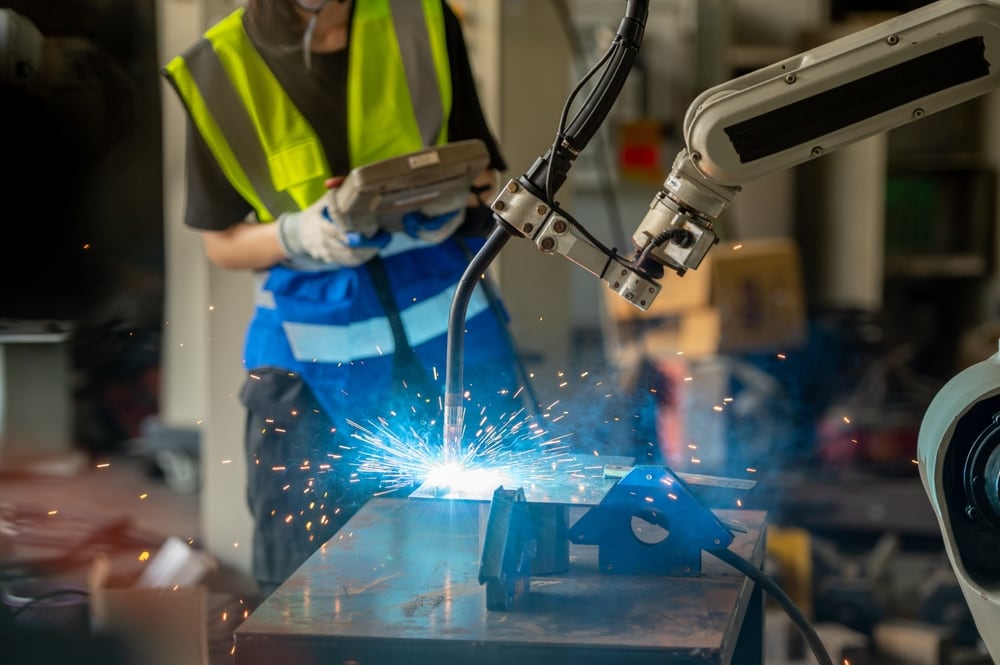
A robotic welding cell is a full system, not just one machine. It includes a robotic arm, a wire feeder, a power source, fixturing to hold the part, a safety enclosure, and a control system for programming. Two well-known robot brands we work with are Yaskawa Motoman and OTC Daihen.

Robotic welders can perform many of the same processes as manual welding, including MIG, TIG, and pulsed MIG. Many cells also use laser welding with seam tracking, which helps the robot follow a weld path precisely, even on tricky parts. Cobots, or collaborative robots, are a smaller option. They work near people without a full safety cage, though they usually run at a slower pace than a fenced-in robotic cell.

The biggest difference between manual and robotic welding is how much of the shift is spent actually welding. A skilled human welder typically welds for a modest portion of each shift, with the rest going toward positioning parts, changing jobs, and taking breaks. A robotic cell can spend the large majority of a shift welding. That gap adds up fast across a full day, week, or year.

Speed, Precision, Quality, and Safety Side by Side

When shops compare manual and robotic welding, a few things tend to matter most: how fast the welds go, how consistent they are, and how safe the process is. Robotic welders typically travel faster than manual welders, which means more parts finished per shift. That speed gap grows even wider once you factor in total welding time, not just travel speed alone.

Robotic Welding vs. Manual Welding: Performance Comparison

Metric Manual Welding Robotic Welding Key Differences
Travel Speed 18in/min–20in/min. 35in/min Robots operate at a 75%–95% faster travel speed, reducing cycle time per part.
Arc-On Time 50%–60% of shift 75%–85% of shift Robots maintain continuous operations. Humans need breaks, have skill variations, and changeovers reduce productive time.
Repeatability Tolerance ± 0.10mm–0.15mm ± 0.025mm Modern robots achieve 4x–6x tighter tolerance, ensuring uniform weld quality across all parts.
Defect Rate 3%–8% <1% Robotic consistency eliminates human fatigue and concentration drift with fewer rework costs.
Per-Hour Loaded Cost $45/hr–$75/hr $25/hr–$40/hr An initial equipment investment of $37,000–$49,000 for robotic welding is recovered through reduced labor and scrap within 1–3 years.
Duty Cycle 50%–65% 85%–95% Robots run continuously across shifts. Manual work includes setup, rework, fatigue, and changeover downtime.
Safety Exposure High Heat, fumes, UV radiation, ergonomic strain. Minimal Operator supervision. Cobot design prevents collisions. Robotic welding removes operators from hazardous heat/fume zones. Robots have built-in vision and collision detection, which enhance workplace safety.
Safety and Programming Time Minimal for an experienced welder. Hours for new jobs. Hybrid workflows allow quick adaptation for repeat jobs.

Robots also hold tighter tolerances than a human hand can manage. This means nearly every weld on every part comes out close to the same, which matters a lot for parts that need to fit together precisely. Because of this consistency, robotic welding usually produces fewer defects and less rework than manual welding does.

Programming a robotic cell for a brand-new job does take time upfront, sometimes a good chunk of a shift for the first test run. An experienced welder, on the other hand, can often start a new manual job with very little setup. This is one reason robotic welding pays off best on repeat jobs, not one-time work.

Safety is another piece of the puzzle. Manual welding puts workers close to heat, fumes, bright light, and repetitive motion, which can wear on a welder over time. Robotic cells keep workers farther away from those hazards and use built-in sensors to help prevent collisions.

Weighing the Investment and Working Together

A robotic cell costs more upfront than a manual welding station, but it can pay for itself over time. Shops typically weigh the total cost, including setup and training, against the labor savings, faster output, and lower rework it delivers each year. Many shops find their cell pays for itself within a reasonable window, though this can stretch longer for complex, low-volume work. Tax incentives can also shape how quickly new equipment pays off, so it’s worth asking your accountant what deductions might apply to your shop.

We can walk through this process with you, looking at your current bottlenecks, your future capacity needs, and which solution actually fits, rather than pushing the biggest or most expensive option.

You also don’t have to choose only one path. Most successful shops use manual and robotic welding together. High-volume, repeatable parts move through the robotic cell, while manual stations stay open for prototypes, repairs, and smaller custom jobs that wouldn’t pay off with a robot.

This kind of hybrid setup also gives your most experienced welders new value. Instead of stepping away, they can program the robotic cell, check its first welds, and handle the tricky jobs a robot can’t manage. This helps shops hold onto valuable know-how even as experienced welders retire.

Avoiding Common Setup Mistakes

Robotic welding works best when the parts feeding into it are consistent. If your cutting and bending processes produce parts that don’t fit together closely, a robot may struggle where a skilled human hand could adjust on the fly. Fixing upstream fit-up issues first often makes the biggest difference in final weld quality.

Other common mistakes include under-built fixturing, skipping test runs before full production, and treating a robotic cell like a simple plug-and-play machine. A robotic welding cell is an engineered system, and it works best when it’s planned carefully and tested first. We offer welding cells built to work alongside your existing manual stations, so you don’t have to overhaul your whole shop at once.

  • Pre-install site visit and planning
  • Machine calibration and first-run testing
  • Operator training and safety sign-off
  • Ongoing preventive maintenance
  • Fast, local repair support when you need it

How We Help You Decide and Get Started

Choosing the right welding setup is a big decision, and we’re here to help you make it with confidence. We work with shops as a hands-on partner, helping you evaluate your options honestly, whether you’re adding capacity, replacing older equipment, or trying automation for the first time.

You can also see a robotic welding cell running in person before you commit to anything. We have technology centers across the country where you can bring your own parts and test how a robotic cell handles your shop’s actual work.

Our team of factory-trained field service technicians, backed by a dedicated service department, supports the equipment we sell long after installation is complete. With decades of experience in metal fabrication equipment, we’re ready to help your shop run safer, faster, and more efficiently. Contact us today to talk about what’s next for your welding operation.

Why Robotic Welding ROI Looks Different Than It Did Five Years Ago

Robotic welding is no longer just a way to add new technology to your shop. Today, it is a smart business decision that can help you increase production, improve weld quality, and make better use of your workforce. Many manufacturers struggle to find experienced welders, keep up with growing demand, and maintain consistent quality. At the same time, customers expect faster turnaround times without sacrificing precision. Robotic welding helps solve these challenges by making production more efficient and repeatable.

However, the true return on investment, or ROI, is about much more than replacing manual labor. It comes from improving every part of your operation, from reducing scrap and rework to increasing throughput and creating room for future growth. At Capital Machine, we help manufacturers understand the complete picture. Our goal is to recommend the right robotic welding solution based on your production needs, facility, and long-term business goals so you can make a confident investment that continues to deliver value for years to come.

What Really Drives Robotic Welding ROI?

Many people think robotic welding pays for itself only by reducing labor costs. While labor savings are important, they are only one part of the equation. The biggest return often comes from making your entire operation more productive and efficient.

The greatest ROI improvements often come from:

  • Higher production output with faster cycle times
  • More consistent weld quality with less rework
  • Better use of skilled employees for higher-value work

A robotic welding system can help you complete more work in less time, improve weld consistency, reduce material waste, and lower the amount of rework required after production. When every weld is more consistent, your team spends less time fixing mistakes and more time completing customer orders.

Robotic welding also allows skilled employees to focus on higher-value work instead of repetitive welding tasks. This helps manufacturers make better use of experienced workers while reducing the impact of labor shortages. Instead of turning away new business because of limited staffing, many shops can increase production capacity without adding more employees. Over time, these improvements often create more value than labor savings alone.

At Capital Machine, we encourage manufacturers to look beyond the purchase price of a robotic welding system. The real question is how the system will improve your operation every day. When you evaluate productivity, quality, efficiency, and future growth together, you gain a much better understanding of your long-term return on investment.

Understanding the Costs Before You Invest

Every manufacturing operation is different, which means every robotic welding solution should be planned carefully. The equipment itself is only one part of the investment. A successful project also includes proper installation, operator training, programming, fixturing, maintenance planning, and ongoing support. These important details are sometimes overlooked during budgeting, leading to unexpected costs later.

Planning ahead helps prevent surprises and keeps your project moving smoothly. Before selecting a robotic welding solution, it is important to understand your production goals, available floor space, current workflow, and future growth plans. A system that works well for one manufacturer may not be the best fit for another. Choosing the right equipment from the beginning helps improve performance while avoiding unnecessary expenses.

At Capital Machine, we take a consultative approach to every project. We begin by learning about your production challenges, equipment needs, and long-term objectives. From there, we recommend solutions that match your application instead of trying to fit every customer into the same system.

Our support continues long after the equipment arrives. We provide installation supervision, machine setup, operator training, and ongoing service to help your equipment perform at its best. By helping customers prepare for every stage of implementation, we reduce risk, shorten startup time, and help manufacturers begin seeing results as quickly as possible.

How to Measure Payback the Right Way

Calculating robotic welding ROI should never be limited to comparing equipment costs with labor savings. A complete evaluation considers how automation affects nearly every part of your production process. Faster cycle times, better weld quality, reduced scrap, lower overtime, increased throughput, and improved equipment utilization all contribute to the overall return.

Another important factor is production capacity. When robotic welding allows your shop to complete more parts in the same amount of time, you may be able to accept additional customer orders without expanding your workforce. That additional production can become one of the largest contributors to long-term profitability. Likewise, reducing rework and improving first-pass quality helps lower operating costs while keeping customer satisfaction high.

A realistic ROI calculation should also include operating expenses such as maintenance, programming, equipment utilization, and planned downtime. Looking at the complete picture gives manufacturers a more accurate understanding of how quickly their investment may pay for itself.

At Capital Machine, we help customers evaluate these factors before making an investment. By understanding your production goals and current workflow, we can help you estimate realistic performance improvements and identify the solution that offers the greatest long-term value for your operation.

Choosing the Right Robotic Welding Solution for Your Shop

Not every welding operation has the same production goals, so not every robotic welding system should be the same. Choosing the right solution starts with understanding your workflow, production volume, part sizes, and future growth plans. Some manufacturers produce a wide variety of parts in smaller quantities and need a flexible system that can handle frequent changeovers. Others run the same parts every day and benefit from a fully automated robotic welding cell designed for continuous production. In some situations, manual welding may still be the best choice for custom work or one-time projects.

The goal is not simply to automate. The goal is to invest in equipment that improves productivity while fitting naturally into your existing operation. That is why every project should begin with a careful review of your manufacturing process rather than focusing only on equipment specifications.

At Capital Machine, we help customers compare their options based on real production needs. We evaluate your current workflow, identify opportunities to improve efficiency, and recommend robotic welding solutions that support both your immediate goals and your long-term growth plans. This approach helps you make a confident investment that continues to deliver value as your business evolves.

Protecting Your ROI After Installation

Purchasing a robotic welding system is only the beginning of your investment. Long-term ROI depends on keeping your equipment running efficiently every day. Even the best robotic welding system cannot deliver consistent results if it is not properly maintained, operators are not fully trained, or small maintenance issues are allowed to become larger problems. Preventing unexpected downtime is one of the most important ways to protect your investment.

Regular maintenance helps identify wear before it causes equipment failures. Ongoing operator training helps employees use the equipment safely while getting the best possible performance. Fast service support also reduces downtime when repairs are needed, allowing production to resume more quickly.

At Capital Machine, we remain your partner long after installation is complete. We provide installation supervision, preventive maintenance programs, operator training, application support, repairs, and ongoing technical service to help your robotic welding system perform reliably. Our experienced technicians work closely with customers to keep equipment operating efficiently so manufacturers can continue meeting production schedules, maintaining quality, and maximizing the value of their investment for years to come.

Why a Consultative Approach Leads to Better Results

One of the biggest mistakes manufacturers can make is selecting robotic welding equipment based only on price. While purchase cost is important, choosing the wrong solution can limit productivity and reduce long-term value. Every shop has different production requirements, staffing challenges, quality goals, and expansion plans. A robotic welding system should be selected based on how well it supports those specific needs.

A consultative approach helps manufacturers make informed decisions before equipment is purchased. Instead of focusing only on the machine itself, the entire production process is evaluated. This includes reviewing current bottlenecks, production capacity, workflow, future growth opportunities, and facility requirements. Taking time to understand these details helps ensure the equipment delivers the greatest possible return over its entire life.

At Capital Machine, every customer relationship begins with listening. We take the time to understand your operation, your challenges, and your goals before recommending a solution. Our team helps you evaluate production needs, select the right technology, prepare for installation, and build a plan for long-term success. This process reduces uncertainty and gives manufacturers greater confidence that their investment will continue supporting their business for many years.

Ready to Discover Your Robotic Welding ROI?

Every manufacturing operation is different, which means every ROI calculation should be different as well. The best investment is not always the least expensive option. It is the solution that helps your shop increase productivity, improve quality, reduce waste, and create capacity for future growth. By looking beyond labor savings and considering your complete production process, you can make a more informed decision that delivers lasting value.

At Capital Machine, we work alongside manufacturers to help them choose robotic welding solutions that fit their operations today while supporting their goals for tomorrow. From the first conversation through installation, training, preventive maintenance, and ongoing service, we are committed to helping you get the most from your investment.

If you are considering robotic welding, replacing aging equipment, expanding production, or improving efficiency, contact us today. We will take the time to understand your operation, answer your questions, and recommend a solution designed around your specific needs. Together, we can help you build a safer, more productive, and more competitive manufacturing operation.

Why Small Shops Are Finally Pulling the Trigger on Robotic Welding

A chronic shortage of skilled welders, demand for higher throughput, and rising wage pressure have flipped the “automation is for big shops” assumption. Small fabrication shops are adopting compact robotic welding cells to maintain production levels, scale output without requiring new hires, and meet strict contractor deadlines.

Small shops with $1 million to $25 million in revenue are now prime candidates to make the switch to a robotic welding system. According to the American Welding Society there was a 400,000-welder shortage in 2025. Robotic welding for small shops can help meet output without sacrificing margins. Cobots and compact cells as small as 15 sq. ft. make robotic welding viable in existing floor space. The real question isn’t are we big enough? The question should be: Which parts in our mix run long enough to justify a robotic cell?

This is where Capital Machine can help. Our advisory process includes evaluating current production bottlenecks, projecting capacity needs, and recommending technology-matched solutions that meet your shop’s application needs. We are a dealer, service provider, and value-added distributor that not only has the top-of-the-line robotic welding systems for sale, but we also provide comprehensive services that keep equipment working.

Contact Us Today

Cobots vs. Industrial Robots: Which One Fits Your Floor?

The practical difference between a cobot and an industrial welding robot boils down to safety, programming, and production scale. Collaborative robots, or cobots, are designed to share a workspace with humans, feature easy hand-guided teaching, and suit low-volume batches. Industrial robots require safety cages, need complex programming, and are built for high-volume mass production. Cobot welders win on ease of deployment, small footprint, and hand-guided teaching. Industrial robots win on speed and duty cycle for repeat runs.

Welding cobots make the most sense for low-volume, high-mix production, frequent station changes, or applications requiring close human collaboration. They are ideal when you lack floor space for bulky safety enclosures, need to automate quickly on a budget, or have part and tool payloads under 30 kg.

Power and Force Limiting (PFL) lets cobots work alongside operators without guarded cages, which matters when floor space is tight (ISO 10218/TS 15066) on cage-free collaborative operation.

Many shops start with a cobot for prototyping and low-volume jobs, then add an industrial cell as volume ramps. Capital Robotics, a division of Capital Machine, supports both paths with Yaskawa Motoman and OTC Daihen systems. We specialize in manufacturing modular robotic weld cells, such as our signature Fusion Arc Welding System, and supplying integrated Metal Inert Gas (MIG) welding and Tungsten Inert Gas (TIG) welding, plasma, and laser welding cutting machines.

The Readiness Checklist Before You Sign a Purchase Order

Readiness Question Checklist

  • Does your shop have parts that require consistent, repeatable welds?
  • Are monthly volumes large enough to justify the move to a robotic cell?
  • Will your fixturing need to be updated to ensure reliable automated welding?
  • Do your applications have predictable joint locations with stable fit-up conditions?

Robotic welding is typically a strong fit for parts that require consistent, repeatable welds and are produced in moderate to high volumes. Parts with predictable joint locations, stable fit-up conditions, and relatively simple weld access tend to perform best in an automated environment.

Larger weldments, multi-pass welds, and components requiring long arc-on times are good candidates as a robotic welding system can improve cycle time consistency and reduce operator fatigue. Manufacturers often see the greatest value when welding processes are repetitive and quality requirements are strict, since robotic systems can deliver more uniform weld penetration, bead appearance, and travel speed than manual welding.

Part stability and dimensional consistency are also important considerations. Automated welding relies on repeatability, so excessive variation in incoming material, cut quality, or part geometry can create programming and quality challenges.

Implementing robotic welding often requires updates to fixturing and part design to improve repeatability and ensure reliable welding automation performance. Fixtures typically need to provide more precise and consistent part location than manual welding setups as robots follow programmed paths with very little tolerance for variation.

Space, Power, and What Your Building Actually Needs

Space Needs

A small-shop robotic welding cell can often fit into roughly 200 to 600 sq. ft, but the actual footprint depends on the robot arm size, part dimensions, safety requirements, and level of automation. A basic single-robot cell with a welding table, safety fencing, and power source may only require an area around 15′ x 15′ to 20′ x 20′ for smaller parts and lower-volume production.

Electrical Power Requirements

Electrical and fume-extraction requirements for a robotic welding cell vary based on the welding process, welding applications, robot size, duty cycle, and facility layout, but most systems require planning for power capacity, ventilation, and environmental safety well before installation.

A typical robotic welding cell will need dedicated electrical service for the robotic welder, welding power source, positioners, safety systems, and peripheral equipment such as conveyors or fume collectors. Many industrial robotic welding systems operate on three-phase power, although smaller shop systems and cobot welding cells may use lower voltage configurations depending on the equipment. Shops also need to account for adequate grounding, disconnects, surge protection, and network connectivity for controls, monitoring, and programming systems.

Capital Machine offers shops installation supervision that covers the technical sequence with a pre-install site survey to verify floor specifications and utility access, machine calibration once the rigger completes physical placement, first run testing to validate quality and performance parameters, and operator sign-off confirming the machine meets acceptance criteria.

Small-Shop ROI: How the Math Actually Works

A realistic payback period for a first robotic welding cell is often between 12 and 36 months, depending on production volume, labor availability, weld complexity, and how consistently the system is utilized. Shops that struggle with welder shortages, overtime costs, rework, or throughput bottlenecks frequently see faster returns because automation can improve arc-on time, weld consistency, and production predictability.

However, many manufacturers underestimate costs related to fixturing, part standardization, operator training, maintenance support, facility preparation, and integration downtime during startup. Some shops also overlook indirect costs such as electrical upgrades, fume extraction, programming support, and future tooling changes.

Tax incentives like Section 179 expensing and bonus depreciation can significantly improve the financial picture by allowing manufacturers to deduct a large portion, or in some cases the full cost, of qualified equipment investments in the year the system is placed into service. This can reduce taxable income, improve cash flow, and shorten the effective payback timeline for companies investing in automation.

Programming a Welding Robot Without a Robotics Engineer on Staff

Many modern universal robot welding systems are designed so experienced welders without prior programming backgrounds can learn to operate them successfully. Today’s systems often use intuitive interfaces that simplify robot setup and adjustment, allowing welders to apply their welding knowledge without needing advanced coding skills.

Hand-Guided

Hand-guided teaching, commonly used with cobots, allows operators to physically guide the robot arm through weld paths while the system records movement points and parameters. One fabricator reported a new hire running a cobot weld job in 20 minutes.

Offline Programing

Offline programming (OLP), on the other hand, involves creating and testing robot programs on a computer simulation before sending them to the welding cell, which helps reduce production downtime and supports more complex automation environments.

Operator training timelines vary based on system complexity, but many welders can learn basic operation, part loading, touchups, and routine programming adjustments within a few days to a few weeks. More advanced programming, troubleshooting, fixture setup, and optimization skills typically develop over time with continued production use and hands-on experience.

Capital Machine also offers operator training at our Atlanta, Georgia training facility or on-site at your facility. Your operators will learn the system they will actually weld on, saving valuable production time.

Service, Uptime, and What Happens After the Truck Leaves

Capital Machine sets itself apart from other vendors with our post-purchase support. We are a dealer, service provider, and value-added distributor that not only has the top-of-the-line machines for sale, but we also provide comprehensive services that keep equipment working.

Our 43-factory-trained field service engineers have parts-stocked vans and are ready to diagnose and service your equipment across our 22-state territory. Our engineers are backed by a 53-member service department ready to assist you. We offer condition-based maintenance programs, operator training and retraining, and application support. We provide the largest dedicated service network in the United States, backed by more than 40 years of fabrication equipment expertise. For more information visit our service page.

Your 90-Day Path from First Conversation to First Good Part

Our process for adding a robotic welding cell includes a part-fit audit, cell selection, fixturing design, install and calibration, operator training, and first-article approval with system design and build typically 8-16 weeks and commissioning at 2-4 weeks.

Capital Machine’s advisory process includes evaluating your current production bottlenecks, projecting capacity needs, and recommending technology-matched solutions that meet your shop’s application needs. The goal is the right cell for your shop’s application mix. Contact us to learn more.