A hydraulic press brake uses pressurized hydraulic fluid to drive a ram downward into sheet metal or plate metal positioned over a die. This generates a controlled precision bending force ranging from 40 tons to over 3,000 tons, making it the most versatile press brake type for shops handling a wide range of material thicknesses and bend requirements.
Unlike a mechanical press brake, which uses a flywheel and crankshaft, or a fully electric press brake, which uses servo motors and either belt-pulley drive or ball screws, a hydraulic press brake offers key advantages such as adjustable stroke with the ability to stop or reverse at any point and full tonnage pressure throughout the entire stroke. This makes them better suited for deep drawing and heavy-plate applications.
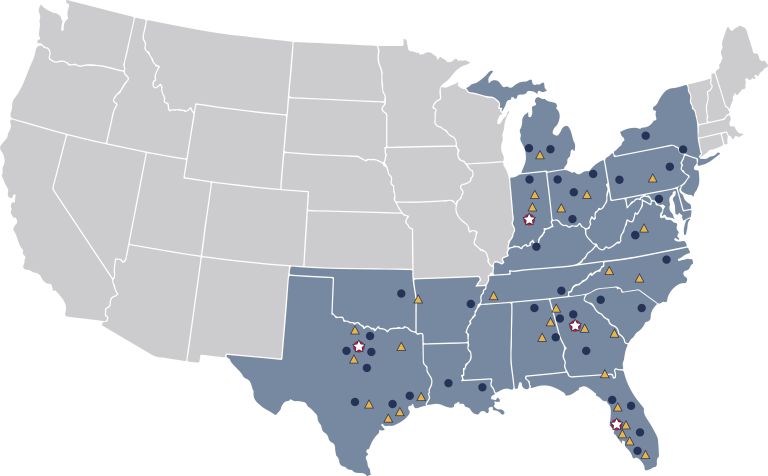
Capital Machine Technologies carries a full portfolio of hydraulic press brakes, including the Accurpress Advantage, Accell-E, Accell-U, and Accell-HT. We have 40+ years of equipment selection experience helping fabrication shops across 22 states choose the right configuration for their production requirements.
Air bending, bottoming, and coining are the three primary bending methods. Air bending is the most flexible method requiring the least tonnage with bending pressure typically only one-third that of coining, as one die can produce multiple angles. Bottoming and coining produce tighter tolerances at higher tonnage requirements.
Tonnage calculation depends on material type, tensile strength, thickness, bend length, and V-die opening width. The industry-standard Rule of 8 suggests the V-die opening should be eight times the material thickness as a starting point, with adjustments for material hardness and desired bend radius.
Capital Machine partners with Accurpress Tooling, Wilson Tools and WILA Tooling along with multiple other planner ground tooling vendors to provide compatible press brake tooling systems. Our equipment specialists help shops select the right punch-and-die combinations for their application mix, preventing costly tonnage miscalculations or tooling damage.
Automotive and aerospace suppliers rely on hydraulic press brakes for forming structural brackets, chassis components, and precision enclosures. This often requires a computer numerical control (CNC) press brake with a control system that offers repeat precision accuracy across production runs of hundreds or thousands of identical parts.
HVAC fabricators, electrical enclosure manufacturers, and job shops use CNC hydraulic press brakes for the versatility to handle multiple part types per shift, with job shops frequently performing numerous different setups per day across varying material gauges. CNC press brakes provide the needed bending force to complete these varied jobs.
Heavy fabrication sectors, such as oil and gas, shipbuilding, power transmission monopoles, and structural steel fabricators, demand hydraulic press brake tonnages of 500 tons to 3,000+ tons for thick-plate bending.
Capital Machine serves these industries across key regions, including Texas (oil and gas), the Gulf Coast (shipbuilding), and the Midwest (automotive and agricultural equipment).
Capital’s condition-based maintenance program uses oil sampling conducted twice per year to monitor your equipment’s health indicators. We are looking to identify wear patterns, contamination, and degradation before they trigger costly, unplanned shutdowns.
Traditional, preventive maintenance relies on fixed schedules, such as annual oil changes, regardless of actual equipment condition. Capital’s condition-based maintenance uses real world diagnostic data to drive interventions only when needed, reducing unnecessary service costs, while catching real problems earlier.
Properly maintaining your equipment improves not only the machine’s performance but also has a significant impact effect on minimizing reliability problems. Keeping your press brakes running efficiently increases your bottom line.
Common faults of hydraulic press brakes include ram drift caused by seal aging and hydraulic leaks, inconsistent bend angles from back-gauge system misalignment or hydraulic system pressure fluctuation, and slow cycle times from valve and pump wear causing slower response. Early diagnosis prevents costly unplanned downtime.
Capital Machine offers customized preventive maintenance contracts with their 53-member service department and 43 factory-trained field service engineers. We have a First Call Fix program where service trucks arrive stocked with critical parts, minimizing repeat visits and production interruptions. Contact us today to learn more.

Capital’s service coverage is unequaled in the industry. To ensure that we are able to provide the fastest possible response times, Capital maintains a fleet of service vans, each strategically located to serve our customers as efficiently as possible.
Each service call is treated with the same priority. Whether the machine is in or out of warranty, Capital is committed to a “First Call Fix” program designed to motivate everyone to expedite the repair quickly and effectively. The map below illustrates our service coverage area.